

Paper-Heavy Trade Finance Grinding to a Halt

A Tier-2 commercial bank with a $1.2 billion trade finance book processing 3,200+ Letters of Credit annually across 18 correspondent banking relationships was losing market share to digitally-native competitors. Each LC transaction involved an average of 12–15 documents — bills of lading, commercial invoices, packing lists, certificates of origin, insurance certificates — all manually reviewed against UCP 600 rules by a team of 28 trade finance specialists.
The average LC processing cycle stretched to 5–7 business days, with a 23% first-submission document rejection rate due to discrepancies that manual reviewers failed to catch upfront. Corporate clients were increasingly migrating their trade finance business to competitors offering 48-hour digital LC processing. The bank's trade finance revenue had declined 14% year-over-year, while operational costs remained stubbornly fixed at $4.8M annually.
Core Roadblocks:
- 5–7 Day Processing Cycle: Each LC required manual extraction and cross-verification of data from 12–15 trade documents against UCP 600 compliance rules, SWIFT MT700/MT799 message formats, and internal credit policies — with no automated document parsing or rule-matching engine.
- 23% First-Submission Rejection: Nearly one in four LC document presentations were rejected on first review due to undetected discrepancies — incorrect Incoterms, mismatched quantities between invoices and bills of lading, or expired insurance certificates — causing costly amendment cycles and delayed shipments.
- Revenue Erosion & Client Attrition: Corporate clients with cross-border trade volumes exceeding $50M annually were migrating to competitors offering digital-first LC processing. The bank had lost 8 marquee accounts in 18 months, directly eroding $6.2M in annual trade finance fee income.
The myAiLabs Ecosystem
Deploying myAiLabs' full suite of AI Agents transformed the bank's trade finance operations from a document-heavy, manual-review bottleneck into an intelligent, autonomous processing engine. By replacing paper-based workflows with AI-driven document intelligence, the bank achieved near-real-time LC processing while dramatically improving discrepancy detection and regulatory compliance.
Intelligent Trade Document Processing
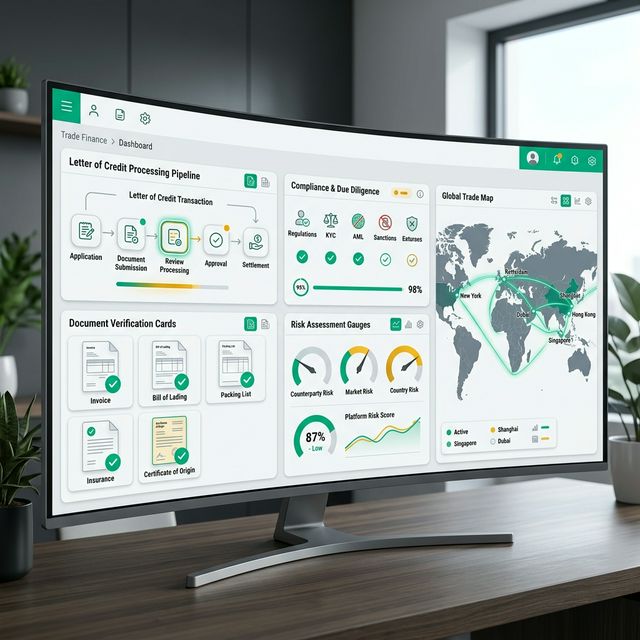
The AI-powered trade document engine fundamentally reimagined how the bank processes Letters of Credit. Every incoming LC document set now flows through an automated pipeline: documents are classified by type within milliseconds, structured data is extracted using domain-trained OCR models, and cross-document validation runs against UCP 600 rules in real time. The intelligent matching engine compares invoice quantities against bills of lading, validates Incoterms consistency, checks insurance coverage adequacy, and verifies beneficiary details across all documents simultaneously — flagging discrepancies with specific rule citations. Trade specialists now receive pre-validated document sets with AI-generated discrepancy reports, shifting their role from manual checking to exception-based adjudication. The result: LC processing dropped from 5–7 days to 1.3 days on average, first-submission rejection rates fell from 23% to 4.1%, and the bank recovered 6 previously lost corporate accounts within the first year of deployment.
Metrics That Matter

The myAiLabs Agentic ecosystem delivered measurable, audit-verified improvements across every dimension of the bank's trade finance operations within 12 months of deployment.
Faster Processing
LC processing cycle reduced from 5–7 business days to 1.3 days through automated document parsing and UCP 600 rule matching.
Detection Accuracy
Document discrepancy detection accuracy up from 77% in manual review to 94% with AI-powered cross-document validation engine.
Annual Savings
Trade operations cost reduced from $4.8M to $2.2M annually through staff reallocation, eliminated amendment cycles, and recovered client revenue.